Trade with
discipline.
Own every move.
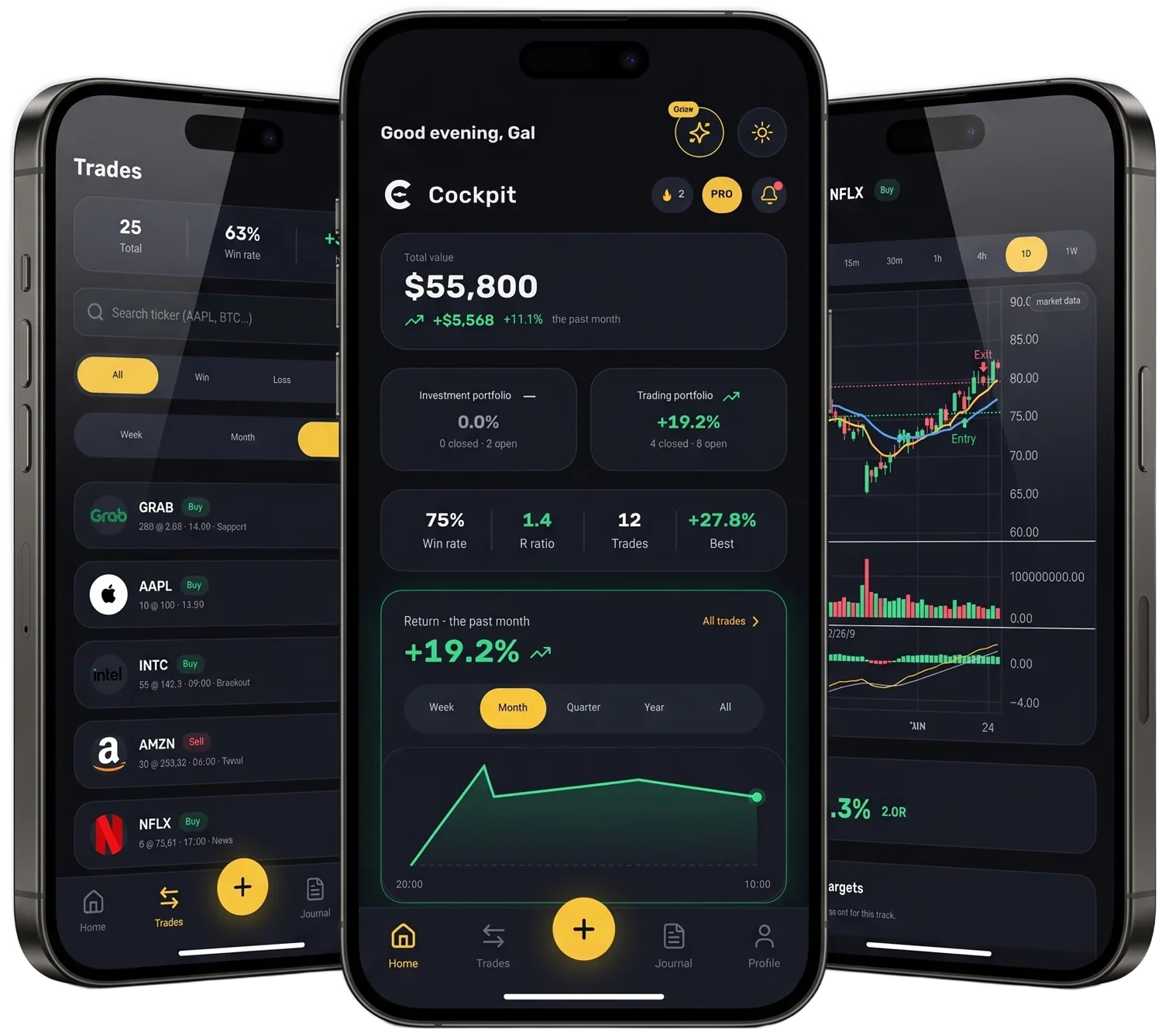
A trading journal for recording your trades. Log a trade in seconds, see your win rate, return and R, and build a record you can hand to someone else.
Opening soon. Leave your email to stay updated.
The evidence
Five findings,
none of them ours
Every number below is a regulator's own measurement or a published study, named underneath it. Four of them describe the problem. The fifth is the only thing anyone has measured that helps.
-
74–89%
of retail CFD accounts in the EU lose money.
European Securities and Markets Authority, product intervention analysis, 2018.
How it was measured
Not a survey. The regulators made every broker in the EU publish its own figure, then measured the range across jurisdictions. Average loss per client: €1,600 to €29,000.
-
Under1%
of day traders are predictably profitable after fees.
Barber, Lee, Liu and Odean, Taiwan Stock Exchange, 1992–2006.
How it was measured
Not a sample of volunteers — every single day trader on one national exchange, followed for fifteen years. Aggregate performance was reliably negative in fourteen of them.
-
0.4%
earned more than a bank teller. Time at it did not fix that.
Chague, De-Losso and Giovannetti, “Day Trading for a Living?”, 2020.
How it was measured
19,646 people who took up day trading, tracked from their first day. The same study reports no evidence of learning: staying at it longer did not turn into skill.
-
56%
of finance influencers were “antiskilled”. They had more followers than the skilled ones.
Kakhbod, Kazempour, Livdan and Schürhoff, “Finfluencers”, StockTwits data.
How it was measured
Over 29,000 accounts, graded against what the market actually did next. Following them cost −2.3% a month; only 28% were skilled — and the antiskilled ones had more followers, more activity and more influence than the skilled ones. Nothing on the screen tells the two apart.
-
29.6%
is what investors remembered earning. Their statements said 21.6%.
They listed their main stocks from memory, then copied the same stocks from their brokerage statements. Memory added eight points, and the losses were what it dropped first: 39.7% of the losers were forgotten, against 29.9% of the winners. This is a result about memory, not about skill — and memory is exactly what a record replaces.
Walters & Fernbach, “Investor memory of past performance is positively biased and predicts overconfidence”, PNAS, 2021.
How it was measured
They listed their main stocks from memory, then copied the same stocks from their brokerage statements. Memory added eight points, and the losses were what it dropped first: 39.7% of the losers were forgotten, against 29.9% of the winners. This is a result about memory, not about skill — and memory is exactly what a record replaces.
What follows from it
Four of those five are why this exists. The fifth is how it works: write the trade down while you still remember why you took it, let the numbers be computed rather than typed, and judge anyone teaching you — including anyone on this platform — by a record computed from the trades they logged.
How it works
One trade, from
the second you take it
Seven steps, and each one hands something to the next. The last two are the reason the first five are worth doing.
-
You log it, in seconds
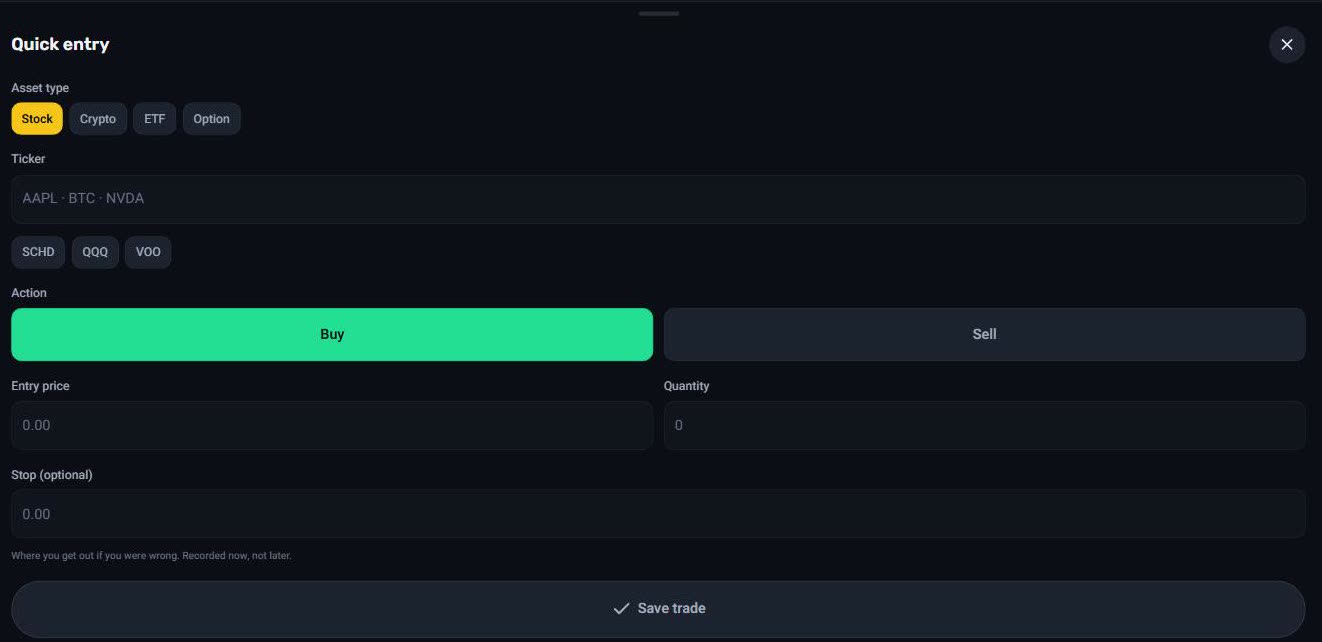
Asset type, ticker, side, price, quantity. The stop is optional, and it is recorded with the entry — not added later. Why you took it and how it felt are tagged as you go.
The part you will want in three months gets captured at 16:32, not reconstructed from memory.
-
It gets a time you cannot change
The server stamps the moment you logged it, and it cannot be edited later. On crypto, the entry is drawn on the candles that actually traded, with the data source named on the chart. You may attach a broker screenshot as well.
When you took the trade is a fact on the record, not something you typed in afterwards.
-
It runs, and the market tells you
Targets and a stop sit on the position. Beside them, six kinds of condition — a price level, price against a moving average, a moving-average cross, a MACD cross, an RSI level, a volume spike — checked on every candle close, and what fires lands in the app.
You stop sitting in front of the screen to find out.
-
It closes, and scores itself
R on every closed trade that has a stop, plus win rate, return and your best result — across two portfolios, four asset classes and, on crypto charts, seven timeframes and fourteen indicators. In Hebrew or English, right to left or left to right.
The number is computed from what you entered. Nobody types it in.
-
You read it back
The journal puts what you did, why you did it and how it felt side by side, day by day. Filtered by week, month, quarter, year — or all of it.
This is the step the 29.6% above is about: a record written at the time, instead of a memory that improves with age.
-
Trader & mentor
Someone who teaches you answers on the trade itself
A mentor you approved sees your trades with their charts and replies in a thread on the trade — not in a message that arrives three days later with the context gone. On his side, every student sits in one place, with who has moved since he last looked.
Feedback lands on the decision it is about, while you still remember making it.
-
Before you pick a teacher
And you can see who is worth learning from
Every mentor's record is the same computed number yours is. Next to it sits the aggregate result of the students already learning from him — shown only from three students up, in percentages and R and never in money, and only if he publishes his own record too.
You choose a teacher by a record computed from the trades he logged, instead of by a screenshot.
More is being built.
Logging a trade takes
seconds, not minutes.
Five fields
Asset type, ticker, side, price, quantity. The stop is optional and is recorded with the entry.
Why, and how it felt
Tagged as you go. It is the part you will want in three months, and the part nobody types into a spreadsheet at 16:32.
A record that survives
being shown to someone
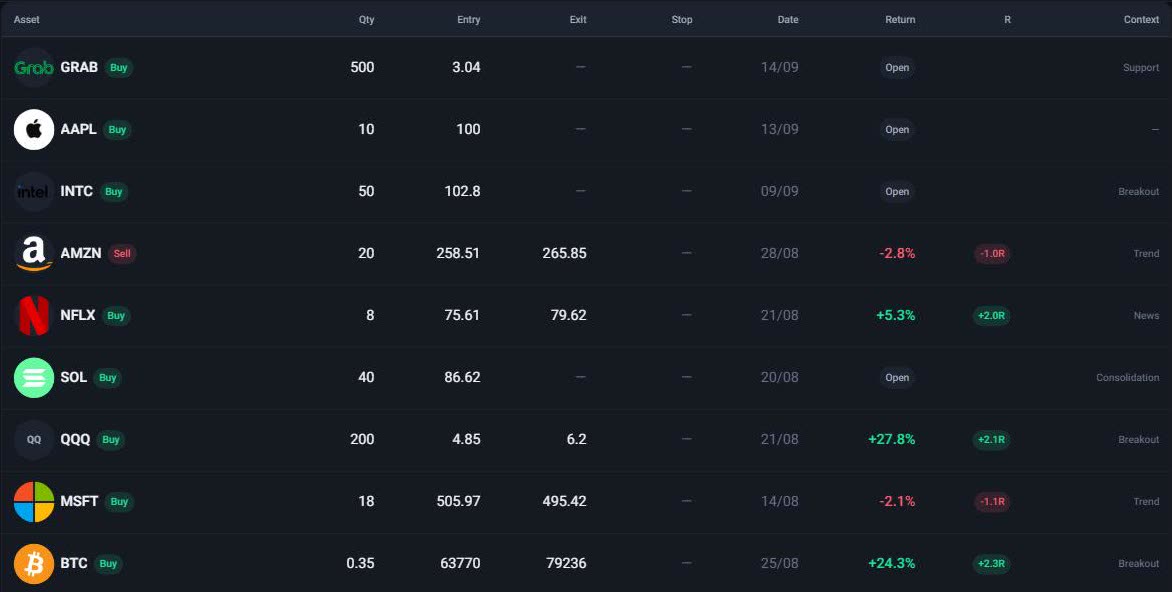
Every closed trade with a stop carries its R. Every screen carries the same three measures. Your account size is never shown to anyone; a mentor you approve sees the trades themselves.
Chague and De-Losso followed Brazilians who took up day trading and stuck with it. Among those who persisted for more than 300 days, 97% lost money. Chague and De-Losso, “Day Trading for a Living?” (2020).
The market tells you.
You do not sit watching it.
Put a condition on a symbol and leave. The scan runs on the server every hour against closed candles, and what fires lands in the app.
-
Conditions, not noise
EMA and SMA crossings, RSI, MACD, or a plain price level, on four-hour, daily or weekly candles.
-
Only on a closed candle
Nothing fires on a wick that un-prints a minute later. The condition has to hold when the candle closes.
-
It reports, it does not advise
An alert says a condition was met, and names the symbol, the timeframe and the direction. What you do about it is yours.
Three people open this,
for three reasons
The same record serves all three, because it is the only thing all three can agree is true.
-
You journal for yourself
Nobody sees anything. Trades, tags, notes and numbers are yours, and the only argument the record makes is to you.
-
You are deciding where to learn
Every mentor has a page: his experience, the markets he trades, how he works, and, if he publishes them, his win rate, R and closed trades. From three students up you also see how his students are doing together. Percentages only; nobody's account size appears anywhere.
-
You teach
Your students' trades appear as they happen, read-only, and you see who moved since you last looked. You comment on the trade itself, so the conversation stays attached to the position it is about. You cannot edit their record, which is the whole reason it is worth anything.
The same record,
on the desk
and in your pocket.
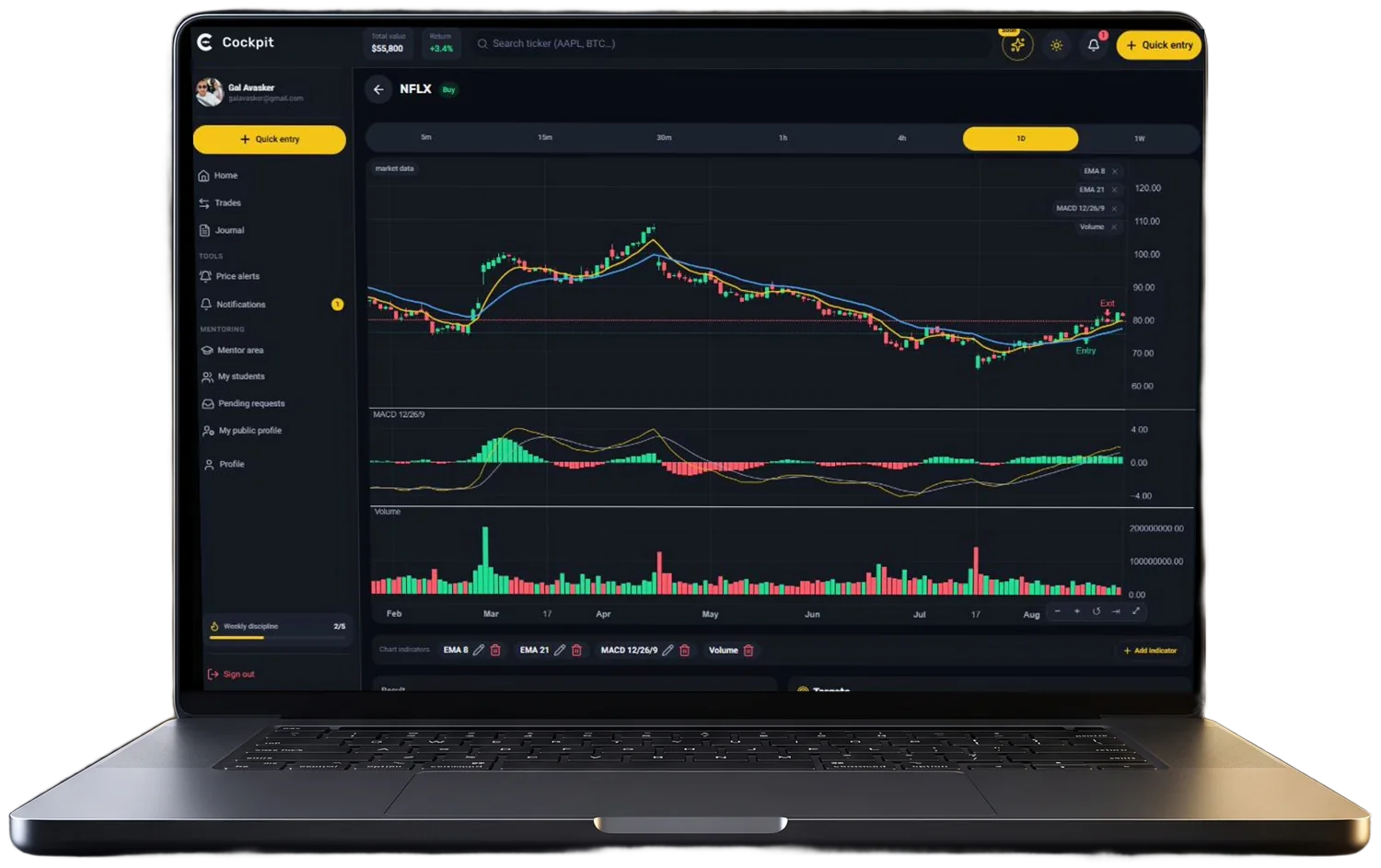
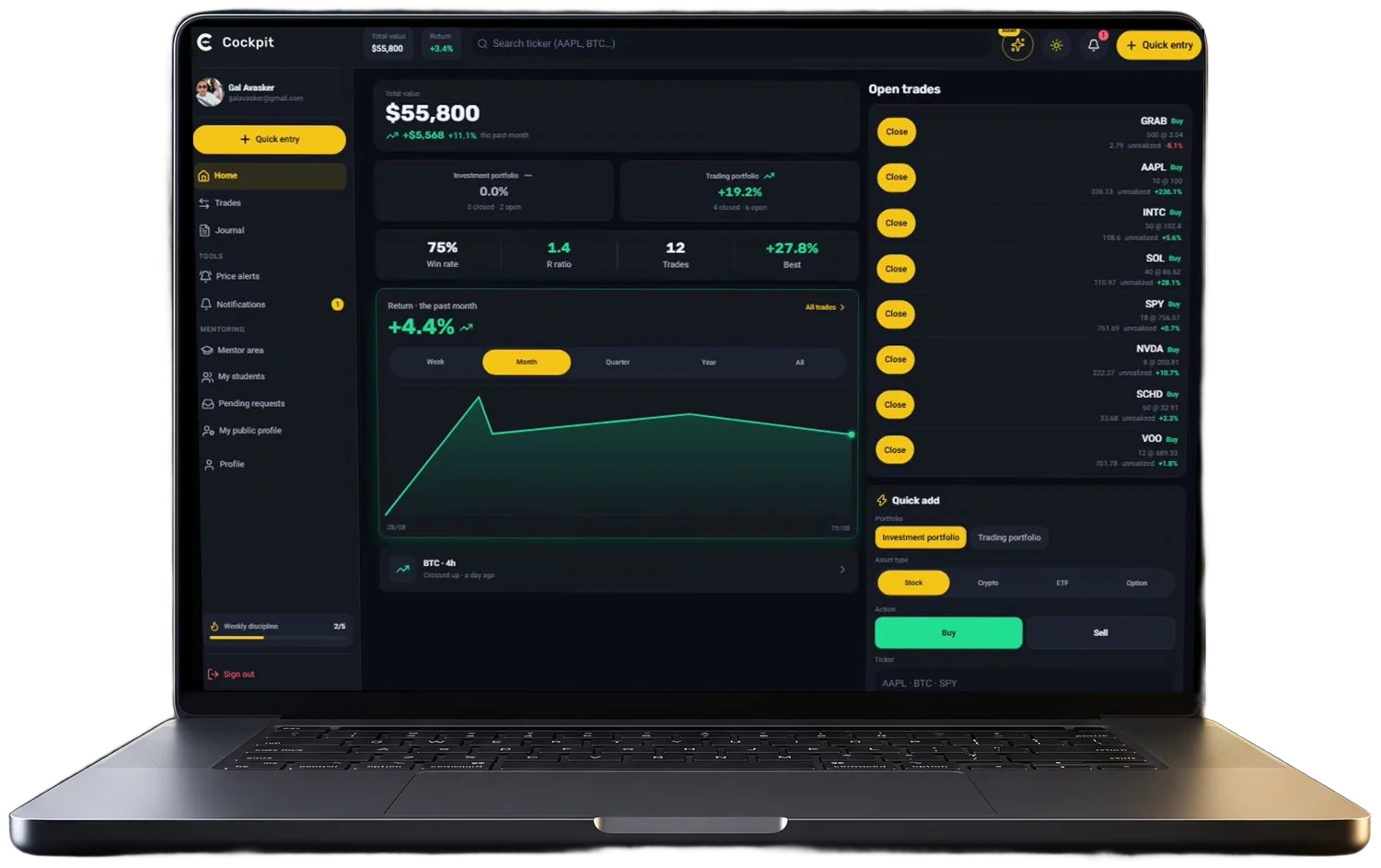
The desktop version holds the same record, not a cut-down view: a persistent sidebar, tables you can filter, candle charts with your own indicators, and the mentor area. The phone is where a trade actually gets logged, in seconds, while the position is still moving.
- iPhone · on the way to the App Store. Android comes after launch.
- Desktop · runs in any browser, nothing to install.
- Hebrew and English · right-to-left built in, not bolted on.
Opening soon.
The app is built and running. Leave an address and you get an email on the day accounts open.
7 days free, then ₪34.90 a month or ₪299.90 a year. Cancel anytime.
or
Get the app
Log the trade where you took it.
The phone app is the same record, and it is where a position actually gets written down — in the minute you took it, not in the evening.
Until then the browser version holds the same record, on a phone as well as on a desk.